
How to Budget for Exterior Home Improvements Without Sacrificing Quality
Quick answer: Are exterior home improvements worth the cost?
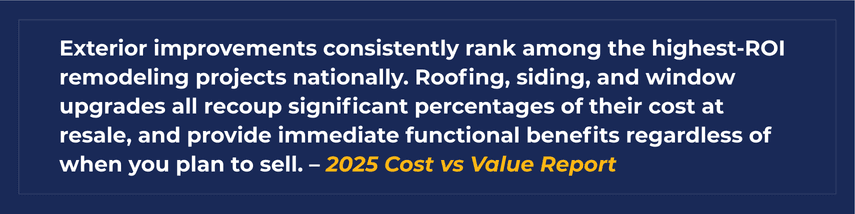
Yes! Exterior projects consistently deliver the highest return on investment of any remodeling category. According to the 2025 Cost vs. Value Report 8 of the top 10 highest-ROI remodeling projects are exterior improvements, with steel entry door replacement returning 216% of its cost and vinyl siding replacement returning 97%. The key to making that investment pay off is budgeting correctly from the start. Account for installation quality, warranty coverage, and long-term product lifespan, not just the upfront price.
Most homeowners planning a roof replacement, window upgrade, or siding project start in the same place: a number they hope they can hit. But a realistic home improvement budget covers more than the sticker price on materials. It accounts for installation quality, permits, disposal, and warranty protection, the factors that determine whether your investment holds up over time.
The good news is that budgeting well for exterior remodeling doesn't require a construction background. But you do need to ask the right questions and understand what goes into a contractor's estimate before you sign anything.
What Should a Home Improvement Budget Include?
A contractor quote gives you a price. A real home improvement budget gives you a complete picture: materials, labor, permits, and long-term protection. Homeowners who plan for all four categories are far less likely to encounter surprise costs mid-project.
Core Cost Categories in Exterior Remodeling
Every exterior project, regardless of size, touches at least four cost areas:
Materials. The product you choose sets the ceiling on how long your project lasts. Architectural shingles perform differently than basic 3-tab shingles. Composite siding holds up differently than standard vinyl. Product selection is a budgeting decision as much as an aesthetic one.
Labor and Installation. Who installs the product matters. Factory-certified installers maintain warranty eligibility that unlicensed or uncertified contractors cannot. Poor installation can void a manufacturer's warranty entirely, leaving you with no coverage and a failing product.
Permits and Disposal. These line items get omitted from verbal estimates more often than any others. Include them from the start so your final number reflects the actual project cost.
Warranty Coverage. A long-term warranty like HomeFix's UltraCare™ Lifetime Warranty reduces future repair costs and protects resale value. When you factor in the cost of replacement cycles over 20 to 30 years, warranty coverage is a budget line item, not a bonus.
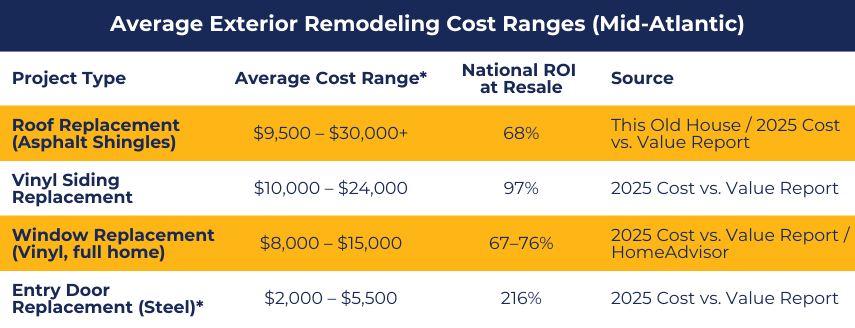
Sources: CSV Report, This Old House, HomeAdvisor, DASMA
*Data based on a large benchmark project (30 squares, full tear-off, architectural shingles) that produces a national average of $30,680. Most Mid-Atlantic homeowners with a typical single-family home will fall between $9,500 and $18,000.
**Door costs based on a standard 20-gauge steel door at an average job cost of $2,435. The $5,500 upper end reflects real-world variation for ProVia-grade certified installations with sidelights or upgraded hardware.
How Remodeling Budget Planning Prevents Costly Mistakes
Reactive budgeting — pricing a project after something fails — almost always costs more than planned maintenance. When a roof fails ahead of schedule, you're working with urgency, limited time to compare bids, and no leverage on pricing.
Structured remodeling budget planning puts you in a different position entirely.
Prioritize by Protection First
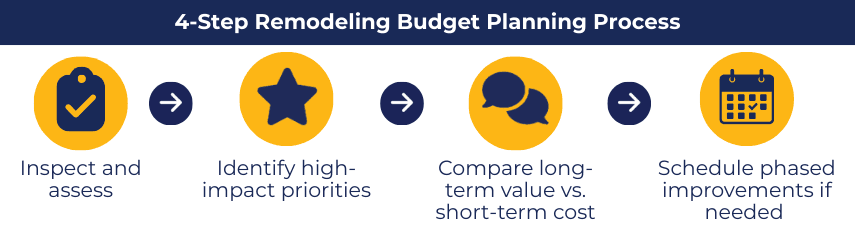
Every exterior component exists in a hierarchy of importance. Structural and weatherproofing systems protect everything beneath them, which means sequencing matters as much as budget allocation.
Roofing and Structural Protection. The roof protects the entire home envelope. A compromised roof leads to water intrusion, mold, insulation damage, and potential structural issues. Each of these creates its own repair budget. Roof replacement is the right place to spend on quality first.
Energy Efficiency Upgrades. Windows with poor seals and outdated frames drive up utility costs year-round. HomeStar™ windows are engineered for the Mid-Atlantic climate, and the energy savings over time offset a meaningful portion of the upfront cost.
Water Management Systems. Gutters and downspouts seem minor until you're looking at foundation repairs. Keeping water away from the home's foundation is one of the highest-return exterior investments you can make.
How to Make Smart Remodeling Value Decisions
Price and cost are different numbers. Price is what you pay at signing. Cost is what you spend over the life of the product, including repairs, early replacements, and lost warranty coverage from substandard installation. Exterior remodeling cost planning that ignores lifespan almost always underestimates the true expense.
Compare Short-Term Price vs. Lifetime Cost
One of the clearest illustrations of this principle is roofing. Consider the difference in outcomes over a 30-year window:
The same logic applies to windows and doors. A ProVia Platinum Plus certified installation on a HomeStar™ window carries manufacturer backing that a non-certified installation on an equivalent product does not. That difference shows up in your budget when something needs attention five years from now.
30-Year Roofing Example
• Standard asphalt shingles typically last 15 to 20 years, meaning most homeowners replace them at least once within a 30-year period.
• Architectural shingles installed by a GAF Master Elite contractor come with extended manufacturer coverage and a stronger warranty baseline.
• Fewer replacement cycles over 30 years means the premium product can cost less in total, even when the upfront price is higher.
• Factory-certified installers also preserve warranty eligibility that unlicensed contractors cannot provide, regardless of product quality.
Financing vs. Phased Home Renovation Budgeting
Cash flow is a real constraint for most homeowners, and any honest conversation about home renovation budgeting has to account for it. The choice between financing a project now and phasing it over time depends less on which option feels safer and more on which one matches your specific situation.
When Financing Makes Sense
Financing works well when the cost of delay is measurable. A failing roof creates risk with every rainstorm. A drafty window is adding to your utility bill every month. In these cases, completing the work now and spreading the payment over time often costs less than waiting.
Financing also locks in current pricing. Material costs in the building industry fluctuate. A project priced today may carry a different number six months from now.
When Phasing Projects Makes Sense
Not every project carries urgency. Cosmetic exterior upgrades — certain siding styles, trim replacements, or aesthetic door upgrades — can wait until after structural priorities are addressed. Phasing works when:
Structural systems are already sound. If your roof, windows, and water management are performing well, cosmetic improvements can follow a multi-year schedule without risk.
Seasonal timing matters for your priorities. Some installations perform better in specific seasons. A phased plan gives you the flexibility to schedule work at optimal times.
- You're planning around a property timeline. Homeowners who plan to sell or refinance in two to four years can sequence improvements to maximize appraisal impact and return on investment.
Why Quality Installation Protects Your Home Improvement Budget
The most expensive failure in exterior remodeling is a quality product installed incorrectly. Materials can perform exactly as the manufacturer intends, but if the installation doesn't meet certification standards, warranty coverage may not apply.
In that case, the labor cost to redo the work comes entirely out of your pocket.
Certified Installation Matters
HomeFix holds certifications that most contractors in the Mid-Atlantic region do not. These credentials are tied directly to manufacturer warranties and, in some cases, to extended coverage options that aren't available through non-certified installers.
GAF Master Elite Roofing. GAF awards Master Elite status to fewer than 3% of roofing contractors nationwide. It requires ongoing training, proper licensing, and demonstrated installation standards.
ProVia Platinum Plus Door Installation. ProVia's Platinum Plus designation recognizes installers who meet the brand's highest installation requirements, which directly affects door performance and energy efficiency.
HomeStar™ Windows. HomeFix's exclusive HomeStar™ energy-efficient windows is available only through HomeFix, which means installation and product are covered under the same quality standards.
UltraCare™ Lifetime Warranty. HomeFix's UltraCare™ Lifetime Warranty provides extended protection beyond what standard manufacturer coverage offers, covering workmanship as well as materials.
Excited to talk about your exterior remodeling project? Contact us today to discuss budget and financing options.
Frequently Asked Questions
What percentage of home value should I budget for exterior improvements?
Most homeowners budget 1 to 4 percent of their home's value annually for maintenance and improvements. A major exterior project like roofing or siding may exceed that in a single year, but both add meaningful resale value that offsets the outlay.
How do I avoid going over my remodeling budget?
Start with a professional inspection so you understand the full scope before pricing begins. Prioritize structural projects first, request transparent written estimates with line-item detail, and work with certified installers who honor manufacturer warranties.
Is it better to finance or pay cash for exterior remodeling?
It depends on urgency and your cash position. Financing prevents delay-related damage from escalating and locks in current pricing. Phased budgeting suits homeowners with a longer planning horizon and no immediate structural concerns.
How do warranties affect my home renovation budgeting?
Long-term warranties reduce future repair costs and increase buyer confidence at resale. HomeFix's UltraCare™ Lifetime Warranty covers both workmanship and materials, extending protection well beyond standard manufacturer coverage.
Does a higher price always mean better quality in exterior remodeling?
Not automatically. What separates a sound investment from an overpriced one is product certification, installation standards, and warranty backing. Price alone doesn't tell you any of that.
Can I visit a showroom to see windows and doors in person?
HomeFix has found that showroom lighting consistently misrepresents how a product looks once it's installed. Instead, HomeFix provides free in-home design consultations. A specialist brings physical samples directly to you so you can evaluate everything in your home's actual light and against your existing finishes.
Contact Us

Monday-Friday: 8am-8pm
Saturday: 9am-5pm
Sunday: Closed
Monday-Friday: 8am-8pm
Saturday: 9am-5pm
Sunday: Closed
Monday-Friday: 8am-8pm
Saturday: 9am-5pm
Sunday: Closed
Monday-Friday: 8am-8pm
Saturday: 9am-5pm
Sunday: Closed
Monday-Friday: 8am-8pm
Saturday: 9am-5pm
Sunday: Closed
*Warehouse location only
Monday-Friday: 8am-8pm Saturday: 9am-5pm Sunday: Closed