
Metal Roof vs. Asphalt Shingles: Which Costs Less Over 30 Years?
Quick Answer
Over a 30-year period, a metal roof typically costs less than asphalt shingles, even though it has a higher upfront price. That’s because a metal roof usually lasts the full 30 years or longer, while an asphalt shingle roof often needs to be replaced at least once during that same time frame. When you factor in replacement costs, ongoing maintenance, and potential energy savings, metal roofing often delivers better long-term value for homeowners who plan to stay in their home.
For most homeowners, the comparison between metal roofing and asphalt shingles starts — and often stops — with the initial quote. Asphalt shingles cost less to install, they’re familiar, and they feel like the safe, practical choice.
Metal roofing, on the other hand, comes with a higher upfront price that can feel difficult to justify, even when people are intrigued by its longevity.
Where that comparison tends to fall apart is time. Roofing is not a short-term purchase, and it doesn’t behave like one. The real cost of a roof reveals itself gradually, through maintenance decisions, repair calls, replacement timing, and the simple reality of how materials age once they’ve been exposed to weather year after year.
When you look at the numbers over 30 years instead of five or ten, the conversation changes.
Why Upfront Roofing Cost Doesn’t Reflect Long-term Value
The upfront price of a roof reflects what you pay today, not how long that roof will protect your home or how much it will cost you over time.
There’s nothing misleading about the initial cost of asphalt shingles. They are genuinely less expensive to install, and for homeowners who need to replace a roof quickly or are managing a strict budget, they can make sense.
Many people choose asphalt because it allows them to solve an immediate problem without stretching financially.
Typical Lifespan of Metal Roofing Compared to Asphalt Shingles
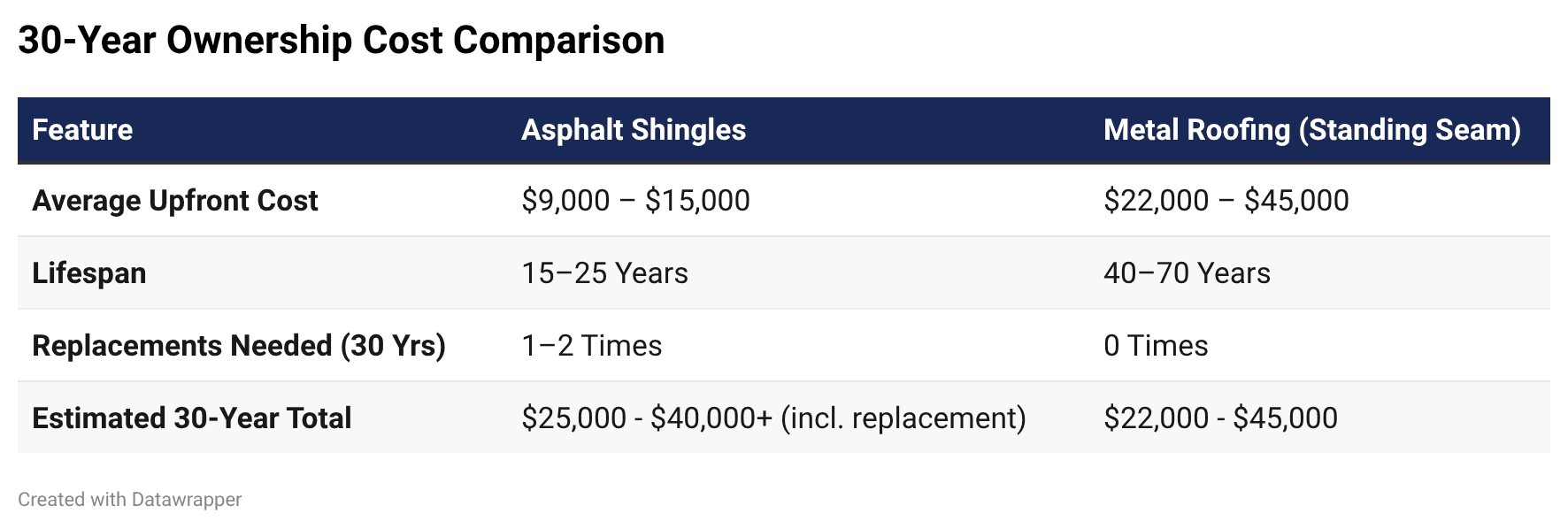
Metal roofing works on a longer timeline. A properly installed metal roof will often last 40 to 70 years. Over a 30-year period, it’s usually a one-time installation rather than a cycle of replacement.
This difference in lifespan is where the cost comparison starts to shift from hypothetical to practical.
How Asphalt Shingles Typically Perform Over 15–25 Years
The part that’s easy to underestimate is how long that solution is meant to last. In real-world conditions, even high-quality architectural shingles typically last somewhere between 15 and 25 years.
In the Mid-Atlantic, where heat, humidity, and storms are part of the normal rhythm of the year, many homeowners discover that their roof is aging faster than they expected.

How Roof Lifespan Affects Cost Over 30 Years
Roof lifespan directly affects 30-year cost because shorter-lived materials often require full replacement within that time frame.
The Full Cost of Replacing an Asphalt Shingle Roof
Replacing an asphalt shingle roof involves more than buying new shingles. You’re also paying for tear-off labor, disposal fees, potential repairs to the roof deck, and the disruption of another major construction project.
This tends to surface during inspections, when contractors explain that patching an aging roof no longer makes sense.
Over time, those costs compound. What originally felt like the more affordable option starts to look less predictable, especially if you plan to stay in your home long term.
Why Metal Roofs Rarely Need Replacement Within 30 Years
A metal roof avoids that cycle. Once it’s installed, it’s designed to remain in place for decades, which eliminates the need to budget for another full replacement within the same ownership window.
For many homeowners, this is the point where the math becomes clearer, even if the upfront investment still feels significant.
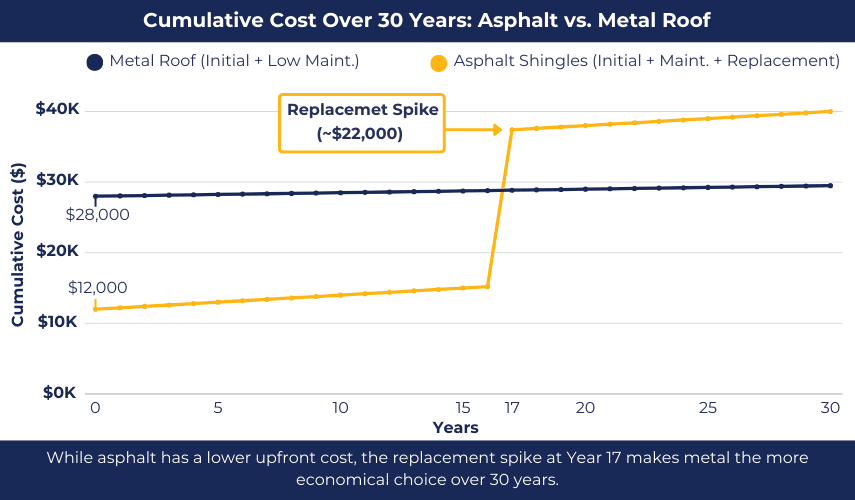
What This Chart Reveals:
The starting advantage: Asphalt's low upfront cost creates an initial $16,000 gap that feels like a win.
The hidden escalation: Maintenance costs quietly compound year after year, but the real damage hits at Year 17.
The replacement spike: That vertical jump shows how a single replacement event erases years of savings.
The long-term truth: Metal's higher starting point becomes the financially smarter choice around Year 17.
Maintenance Costs That Impact Roofing Value Over Time
Ongoing maintenance and minor repairs can significantly increase the total cost of a roof, especially as asphalt shingles age and become more vulnerable to wear.
Typical Repair Needs for Aging Asphalt Shingle Roofs
Homeowners often start to see the same issues recur:
Loose or missing shingles after storms
Granule buildup in gutters
Small leaks that require spot repairs
Flashing that needs repeated attention
Individually, these issues may not feel overwhelming. Over time, they create a pattern of ongoing maintenance that many people didn’t anticipate when the roof was new.
Why Metal Roofs Require Less Ongoing Maintenance
Metal roofing generally requires less intervention. It doesn’t crack, curl, or shed granules, and it tends to perform well in high winds and heavy rain when installed correctly.
While inspections are still important, homeowners often describe metal roofs as something they simply don’t have to think about as often. That’s appealing to a lot of people.

How Roofing Material Impacts Energy Costs Over Time
While energy savings are rarely the main reason homeowners choose a roof, roofing materials can influence long-term cooling costs ovear time.
Energy Efficiency Differences Between Metal and Asphalt Roofs
Metal roofing reflects more solar heat than asphalt shingles, which can help reduce cooling demands during hot summers. The impact varies depending on the home, attic insulation, and ventilation, but over decades, those savings can contribute meaningfully to the overall cost picture.
For homes with significant sun exposure, this is often an unexpected upside that homeowners notice gradually rather than immediately.
How Roofing Warranties Affect Long-term Cost and Risk
Roofing warranties influence long-term cost by shifting financial risk away from homeowners if problems arise years after installation.
How Roofing Warranties Impact Long-term Cost and Risk
Asphalt shingle warranties are often limited, prorated, and closely tied to installation details. Metal roofing warranties tend to be longer and more comprehensive, particularly when the roof is installed by certified professionals.
What matters most to homeowners is not just the length of the warranty, but what it represents: reduced uncertainty and clearer accountability if something goes wrong years down the line.
Which Roofing Option Makes More Sense for Long-Term Homeowners?
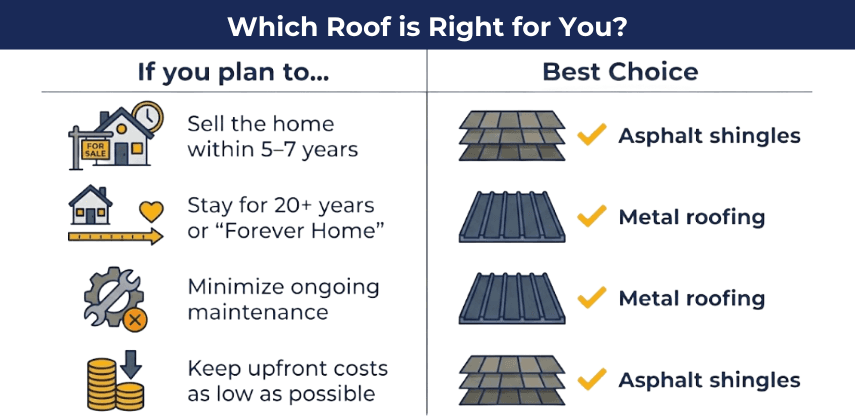
For homeowners planning to stay in their home long term, metal roofing often provides better overall value due to its durability, lower maintenance needs, and reduced likelihood of replacement.
That doesn’t mean metal is the right choice for every situation. Some homeowners plan to move within a decade. Others prioritize the lowest possible upfront expense. Context always matters.
But for people who intend to stay in their home and want to make the decision once, metal roofing frequently proves to be the more economical option in the long run.
Most homeowners don’t regret the roof they choose. They regret realizing, fifteen years later, that they need to choose again.
Why Choose HomeFix for Roof Replacement?
Replacing your roof is a major decision, and who you trust with that work matters just as much as the materials you choose. HomeFix has been helping homeowners protect their homes for more than 30 years, with a focus on long-term performance, certified installation, and care that doesn’t end when the job is done.
With our UltraCare™ Lifetime Warranty, you’ll be able to think beyond the initial quote and make decisions based on decades, not seasons.
Contact Us

Monday-Friday: 8am-8pm
Saturday: 9am-5pm
Sunday: Closed
Monday-Friday: 8am-8pm
Saturday: 9am-5pm
Sunday: Closed
Monday-Friday: 8am-8pm
Saturday: 9am-5pm
Sunday: Closed
Monday-Friday: 8am-8pm
Saturday: 9am-5pm
Sunday: Closed
Monday-Friday: 8am-8pm
Saturday: 9am-5pm
Sunday: Closed
*Warehouse location only
Monday-Friday: 8am-8pm Saturday: 9am-5pm Sunday: Closed